Paul Murphy
Ten Irish women overshadowed by their husbands finally take their place in the sun . A perusal of Irish local newspapers up to the 1970s and early 1980s would reveal a little known fact – Irish women didn’t have first names! If they did the readers of the papers were kept in the dark. True feminists and others would laugh at the very idea but such a phenomenon was certainly known to this writer – women listed in the papers were known as Mrs (Ms had yet to be invented) Paddy X or Mrs Michael Y.
This naming business was accepted as the social norm. Men came first and that was it. It all seems rather pathetic and antediluvian in the light of current advanced enlightenment. A quick scan of M Google will show that Irish women were not consistently known by their husband’s first name but rather a practice of using the husband’s name as a way to identify them in society (Phew!), especially after marriage, became common in many communities, largely influenced by patriarchy (you bet!) and legal traditions, persisting until the mid-to-late 20 th century and remaining popular within the Travelling community. The practice of women taking a husband’s name was linked to the patriarchal practice of coverture, “where a wife had no legal identity separate from her husband”.
Just three of the 10 women written about in this new book by Nicola Pierce – Great Irish Wives – Remarkable Lives from History – are within my own life span, Margaret Clarke (a portrait artist whose life was overshadowed by her stained glass artist husband Harry , Beatrice Behan (interviewed on Rte 19 years after she married Brendan), and Mrs Eamon de Valera, I use that title deliberately because of the almost complete overshadowing of her by her revolutionary, Taoiseach and President husband – in a recording for Rte on his 80 th birthday in 1962 he was asked what were his happiest moments and he listed a number of milestones, the second of which got the reply “and, of course my marriage” (without mentioning the lady’s name). I have searched the internet for a recording of her voice but have yet to find one. These days, if you wish to live a short life just try Mrs Michael Higgins, Mrs Nick Robinson or Mrs Martin McAleese!
It’s just how it was in those dark days. But of course it was demeaning and insulting, just as was the practice of “churching” women immediately after childbirth in case they might contaminate someone. I witnessed the practice as an altar server in my local church – women had to rush to the church within days of giving birth and be “churched” by a priest.
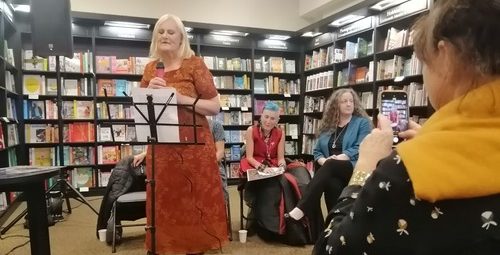
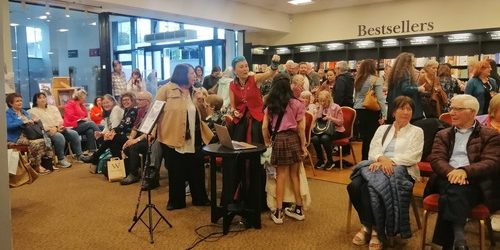
Eleanor Fitzsimons addresses the audience.
Pierce gives us a very sympathetic picture of Sinead de Valera someone, as historian Diarmuid Ferriter once wrote, deserved a biography of her own. She was an award-winning teacher, writer and poet, born Jane Flanagan in Balbriggan. There was the touch of a revolutionary in her family, too. We learn that when Queen Victoria visited Dublin in 1900 Sinead’s father Laurence was in charge of a building crew at St Peter’s Church in Glasnevin. As the royal procession passed the church he instructed his crew to keep their hats on and turn their backs on her!
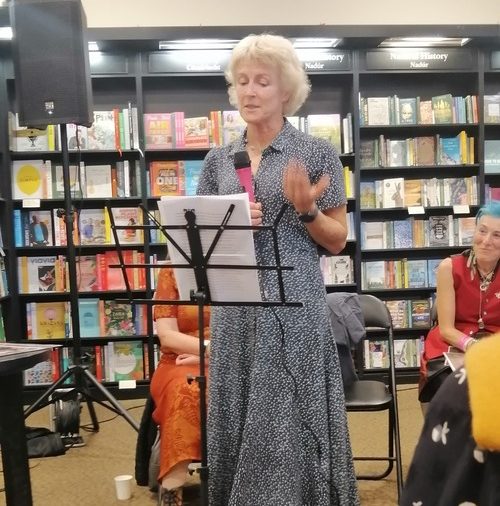
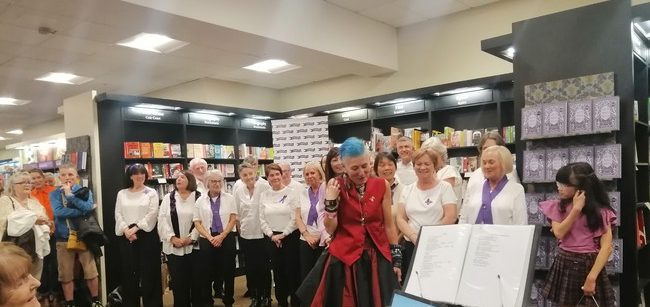
Blanaid Behan also spoke at the launch.
Nicola Pierce also writes that in an article in the Irish Independent in 2019 entitled “Treasured Rediscovered artist shatters stained-glass ceiling” the writer observed that this title was well deserved for an artist whose reputation had been all but blotted out by that of her husband Harry. It was argued that her work was “incisive, insightful and strong”. Margaret, the writer declared “was so much more than Mrs Harry Clarke”.
In Brendan Behan’s case, at least he was honest with his wife. As he lay dying in 1964 he told his wife Beatrice that she had only ever made one foolish mistake in her life – and that was to marry him!. Indeed it must have been tough. Her own family and friends warned her against the marriage saying she would never put up with him. She proved them all wrong and replied “I saw the two days, Brendan, and that is all that mattered”. She was widowed nine years after her marriage.
Writer and historian Ulick O’Connor’s name is mentioned in Pierce’s book and it’s a little like the curate’s egg, good in parts. O’Connor’s name went down badly in the Behan family because of his written allusions to alleged bisexuality on Behan’s part. Yet he also credited Beatrice for her husband’s success, praising her for her “patience and inexhaustible tolerance” of his drinking habits.
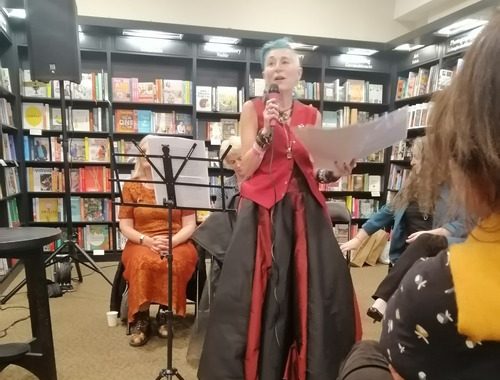
Nicola Pierce speaking at her book launch in Waterstones.
*Nicola Pierce’s book is published by O’Brien Press and was launched at Waterstone’s Bookshop, Drogheda with the help of writer and journalist Eleanor Fitzsimons and Blanaid Behan, Beatrice and Brendan’s daughter. The family of Nicola’s husband Niall Carney, who died as Nicola was writing the last chapter, travelled from Trim for the launch.