Report on the lecture of the Spanish Civil War by Paul Murphy
In these days of ultra convenience most of us needing “a drop of milk for the tay” would drop down to the nearest convenience shop or supermarket and take it in a nice carton from the cool shelf. Ninety years ago on a St Patrick’s Day when Patrick Farrelly from Nobber needed to “whiten” his cup of tea such an option wasn’t available. He had volunteered to fight on the nationalist side in the Spanish Civil War and left his companions to wander down a local street to see if he could seek out his milk.
After his errand was completed he was able to relate a hair raising experience to his shocked companions. Knocking on the door of a local house, he was pleasantly surprised to hear the local senora speak some English and even more grateful when she gestured to him that her husband was “out the back milking the cows”. No sooner had he got round to the back of the house then all hell broke loose – a shell was fired killing the man’s two cows. Another shell was coming in and Farrelly quickly donned his helmet and threw himself to the ground. They say there are no atheists in the trenches and the Nobber man prayed like he had never prayed before. The shell “flattened” the house and the bean an tí ran screaming down the street. No milk that day!
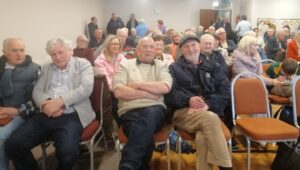
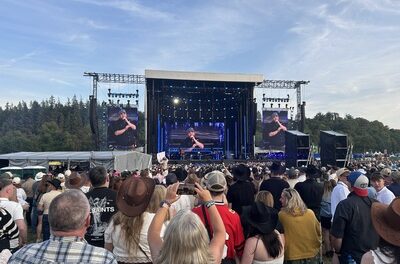
Photographed above some of the audience at the lecture.
This little vignette was delivered by Dominic Muldoon, a member of the Navan and District Historical Society, when he delivered a lecture “Meath and the Spanish Civil War, a story of conviction, conflict and refuge” to society members and supporters in Columbanus Hall in Navan. He said that while he found 18 names of people (17 men and one woman, a nurse) who fought on the nationalist side, he has so far to come across anyone who fought on the republican side.

The Spanish Civil War
The Spanish Civil War (1936-1939) was a brutal conflict between the democratically elected Republican government and a nationalist faction led by General Franco (casualties estimated at between 500,000 and a million) and about 700 Irishmen, including 18 from Meath, travelled to Spain to fight on the nationalist side.
Reports had come through of an Irish trainee priest named Leonard Moran from Rathmolyon in the Irish College in Salamanca who had been living in the Azores but who had had to flee with others on a British navy ship following the outbreak of hostilities. Ireland had taken a neutral stance in the civil war and in fact in 1937 passed the Spanish Civil War Non-Intervention Act which largely prevented Irish people from going to Spain and gave the Gardai enforcement powers to arrest people without warrant. The Fine Gael opposition of the time demanded that the Government recognise the nationalist government of Franco and there was also the formation of the Irish Christian Front.
Irish Brigade under Eoin O’Duffy
The 700-strong largely untrained Irish Brigade under Eoin O’Duffy had just one major, independent engagement while in Spain at the village of Titulcia where they took casualties (six dead, 15 wounded) and failed to overrun the republican-held town. The demoralised brigade refused further orders to attack and were sent home. To say that Spain was unsettled in the early 1930s would be a wild understatement.
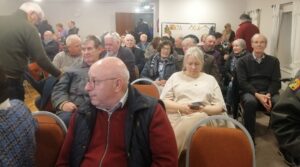
Photographed above more of the audience at the lecture.
In 1931 there was an election called by King Alfonso XIII. He didn’t like the result and abdicated This resulted in the formation of the 2 nd Spanish republic. In 1931, 1933 and 1936 the Spaniards caught the “Irish disease” of the early 1980s, and had elections in rapid succession and they also had the rebellions along with a few failed military coups, major strikes and riots, Muldoon said.
They Had A Terrible Time
“Of the number of Meath people who went to Spain just four – Hubert Hanley, Patrick Farrelly, Thomas O’Dwyer from Trim and Austin O’Reilly – had any kind of military experience. They were drilled from morning to night. They also had issues with the food – for their breakfast they had bread and black coffee, a stew for dinner, and then more bread and black coffee for supper”.They had a terrible time
The Irish brigade had moved at one stage to a place named La Minosa where they were shelled on a daily basis, the waterlogged trench conditions were similar to those in World War 1, there was no clean water and typhoid was rife. Rats and fleas were a constant hazard. “They had a terrible time”, Dominic Muldoon said. Most of the Irish eventually threw in the towel and returned home, in many cases to civic receptions in their home towns in Meath.
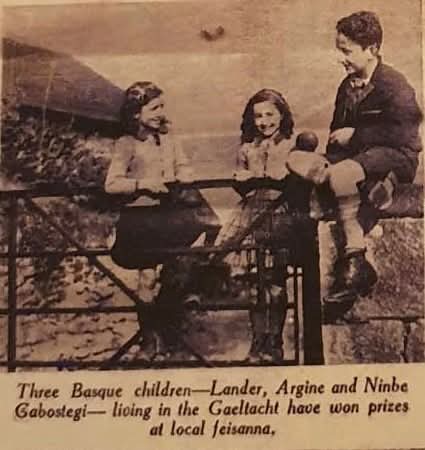
There were refugees from Spain into Ireland following various atrocities and these included the Gallastegi family – Elias, Margarita, Iker, Unai, Lander, Argine, and Ninbe who settled at Gibbstown, a fact well remembered by the local community there, The Spaniards were among thousands of people evacuated from the Basque region. All the children in the family became fluent in Irish and won prizes in local feiseanna and some members played Gaelic and rugby.
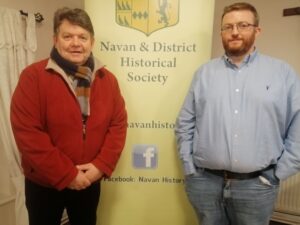
Navan & District Historical Society chairperson Paschal Marry with lecturer Dominic Muldoon
Historical society chairperson Paschal Marry said he felt Dominic Muldoon had captured his subject very well. “It’s not easy to have to stand up and speak about the Spanish Civil War, indeed any civil war”.
Maureen Fanning from Gibbstown who led a large contingent from Gibbstown to the NDHS said it was wonderful that the people of the area were still in touch with the Gallastegi family. Three of the members of the community were very privileged to go to Guernica with Ikor Gallastegi. “They are such a part of Gibbstown and we will never forget them”, she said.
Volunteers who went to Spain
*Volunteers who went to Spain – Patrick Farrelly, Spiddal, Nobber; Hubert Hanly, Cullentry, Enfield; Michael McLoughlin, Ballinlough, Kells; Jack Muldoon, Navan; W. O’Brien (interpretor), Enfield; Patrick Slevin, Fordstown, Chamberlainstown; Tom Tully, Deerpark; Alex Walker, Zephyr Lodge, Kells; Michael Kelly, Ballymahon; Mrs Bridget (Bridie) Mulvaney, Curragh House, Carnaross (nurse); Hugh Healy, Railway Street, Kells; Peter Cahill, O’Growney Terrace, Navan; Michael Finlay, Railway Street, Navan; Julian McDonnell, Balgree Hills, Carnaross; Joe Murray, Rathnally, Trim; Thomas Joseph O’Dwyer, High Street, Trim; Patrick (Austin) O’Reilly, Ennistown, Kilmessan; Dan Tully, Beauparc, Slane.
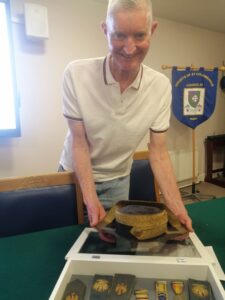
Patrick Gavin and Spanish memorabilia from the Spanish Civil War
Patrick Gavin, Killua and now Johnstown, Navan brought to the lecture memorabilia belonging to his (Spanish) wife’s grandfather who fought on the nationalist side in the civil war, including a tricorn hat and medals of the period.