At a distance of 110 years it may be difficult to pass judgement on reactions of various public figures when it came to commenting on the actions of the revolutionaries who took to the GPO and elsewhere to strike a blow for Irish freedom. Certainly, for many of us, the ‘ouch’ factor might be the predominant reaction to the words spoken by the parish priest of Ratoath, Rev Robert Kelly who described the Rising to his parishioners as “a feeble attempt to establish a toy republic under the jurisdiction of Liberty Hall”.
Then there were the condemnations of the Rising leaders by Drogheda Corporation, and Navan Urban Council (as reported in the Meath Chronicle and Drogheda Independent). And P J Kennedy, substantial farmer from Enfield, peace commissioner and former Justice of the Peace adopted Harold Macmillan’s line (You’ve never had it so good”) in his comments on the leaders – “These men in my opinion – I am not afraid to say it – sinned against God and man; against Ireland and against commonsense. At the time of the outbreak there was not the slightest oppression. Ireland was never so prosperous. To my mind there is a great difference between the various parts which made up the rebellion. To my mind nothing could be too hot or too heavy for what are known as the Citizen Army in Dublin”. Ouch and ouch again!
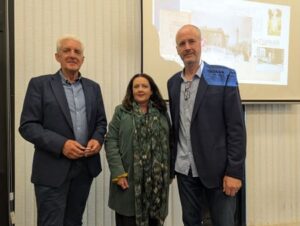
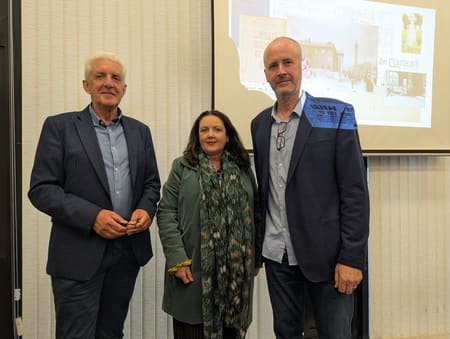
Peter Connell (left) Meath Archaeological and Historical Society, County Librarian Maedhbh Rogan and Tom French of the Local Studies Department of County Meath Library Service at the lecture in Navan Library.
In his lecture at Navan Library entitled – The Easter Rising 1916, 110 years on: Commemoration and History” Peter Connell of the Meath Archaeological and Historical Society said that public perceptions of the Rising have been “fluif” and indeed were subject to change within days of it occurring.
“We know that the Rising was immediately recast by the 15 executions of the leaders and the rounding up and imprisonment pf several thousand men and about 70 women, most of whom had no involvement in the events of Easter Week. By the Summer of 1916 the Rising had been re-made. No longer a shocking, foolish venture, its leaders were now victims of a cruel regime and men in communities across the country were rounded up and imprisoned”.
“Fluid” might be a mild word to use in the context of describing the various national commemorations over the years. Connell says that in 1935 Fianna Fail and Eamonn de Valera were in power and in control of organising an elaborate commemoration at the GPO and the unveiling of the Cuchulainn statue. Dev was flanked by Patrick Pearse’s sister Margaret Mary and Tom Clarke’s widow, Kathleen, both with a direct link to the events 19 years beforehand.

Most Fine Gael TDs boycotted the event and its leader W T Cosgrave reminded Dev that because of the perilous economic state of the country (and the Republic was involved in a trade war with Britain) “it is not possible to hide these national limitations today or to cover them with a veil lifted from the bronze status of Cuchulainn”.
When the 1966 commemorations came along Taoiseach Sean Lemass tried to strike a positive note by referring to “modern Ireland” and its achievements. The theme of the commemorations could be described as “national independence” with the Rising being invoked as an inspiration for the country’s citizens to contribute to the future development of the State.
Fianna Fail might have struck a “bum” note by appointing a committee chosen by Lemass and consisting of Fianna Fail TDs, civil servants and those directly linked to the Rising. Political opponents claimed it would inadvertently, or otherwise, become part of de Valera’s re election campaign for the Presidency. You can hear the defensive cries still – “Never! Thought hadn’t even crossed our minds”.
Peter Connell said that in organising the centenary commemoration there was a general acceptance that “the State did a reasonable job” in designing and managing the commemorations that took place in 2016. But there was that “bum note” again, emerging through a Government promotional video which figured leading personalities like Ian Paisley, Queen Elizabeth, Bono, David Cameron and Bob Geldof while Pearse, James Connolly et all were left mouldering in the grave!