Report Paul Murphy
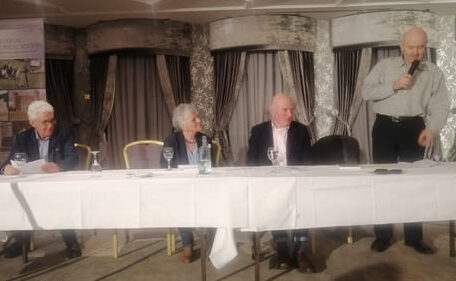
What was life like for the ordinary person in the street during the Irish revolutionary period? That was the theme of a lecture delivered by a TCD professor to an audience of the Meath Archaeological and Historical Society’s launch of its annual journal Ríocht na Midhe in the Ardboyne Hotel. Dr Ciaran Wallace, professor at Trinity College is author of “Meath – the Irish Revolution 1912-23”.
For many people in Meath’s population of the era the answer to what life was like might be “surprisingly humdrum”. They would get up in the morning, get the children ready for school, get the farm running, the shop open. Daily life “worked around” the revolution. The lecturer said he wanted to give the audience little vignettes to show how life progressed. It was the “ordinariness” of life that stood out – for instance, in 1912 the Gaelic League held its annual outing and one of its visits was to Tara.
Sean Boylan with lecturer Professor Ciaran Wallace at the launch of Ríocht na Midhe journal in the Ardboyne Hotel.
There was a “remarkable” amount of social activity going on in the county. A Leap Year Dance was held in Navan and it was adjudged a great success (in a leap year women could ask me to marry them instead of the other way around). Navan Choral Society hosted the opera Maritana in Oldcastle; Navan Dramatic Class members were rehearsing a melodrama. Oldcastle seemed to be a hive of social activity – they had over 60 couples attending the Working Men’s Annual Dance and the ladies of the town made a wonderful supper for the Leap Year Party.
In early March Ballivor Temperance Hall held a dance (alcohol-free) which broke for supper at MIDNIGHT with dancing going on until 6.30am. “So, if you want an all night rave, go to Ballivor”, the lecturer said. On St Patrick’s Day the Temperance Hall in Kilmessan staged two historical plays and the performances finished with a rendition of A Nation Once Again, the “unofficial national anthem of the time”.
On the same night there were performances of Robert Emmet in Julianstown. “People were involved in running things. Civil society did what it did, organising meetings, people were turning up at things, some were writing articles. Sport was enormously important. Needless to say hunting and horseracing and coursing were in full swing. Rugby was a minor interest, soccer barely featured in the papers and obviously by far the most popular sporting occupation was the GAA.
What struck me was the amount of time people spent outside their houses doing things for the community, for themselves. People were members of multiple groups at the same time”. The lecturer said that in the census of 1911 there were about 1,700 people in the county who were over 75 years of age. Some of them might have had childhood memories of The Famine.
The Famine may not have been as severe in Meath as elsewhere but it nevertheless disrupted many other parts of the country. Coming to the expectations people might have had at the time the lecturer wondered if people expected the empire to last forever, were they expecting home rule, an independent republic or were they more concerned about building a house or settling down?
Perhaps people were preoccupied by other things, perhaps the tragic and brutal killing of a schoolteacher John Kelly who had been teaching at an industrial school for seven years. He was set upon by pupils as he crossed the recreation yard and beaten with sweeping brushes and hurleys. There was huge press coverage of the incident and people were horrified at his murder. Two pupils were sentenced to prison for three years for manslaughter. There were three separate inquiries into the incident as society of the time struggled to understand the motive behind it, Ciaran Wallace said.