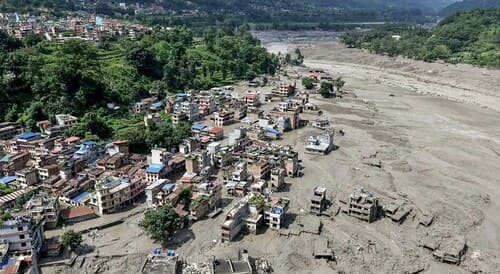
Oxfam is launching an emergency response in Rasuwa and Nuwakot, the districts worst affected by Wednesday’s flash flood, as roads and bridges swept away by the surge have left entire communities almost impossible to reach. On Wednesday, August 26th, a landslide and glacial event around 20km north of the Rasuwagadhi checkpoint blocked the Lhende Khola, triggering a major flash flood. At least 200 people have been killed and hundreds more are missing across Nepal and Tibet.
The surge then swept into the Trishuli River via Timure, Syaprubesi and Bhairabkunda, leaving families along the riverbanks of Rasuwa, Nuwakot, Dhading, Gorkha and Chitwan, in peril. Santosh Pandey, Oxfam Humanitarian Lead in Nepal, said: “Entire neighbourhoods are under mud and rescue teams are still digging. The water rose nine metres in half an hour. What we are seeing so far is only what we can reach. The water rose nine metres in half an hour. What we are seeing so far is only what we can reach. The rivers are full of debris and sewage. Getting clean water and safe sanitation to most affected people into these valleys is the priority now.”
The collapse of roads, bridges and communications has severely hampered relief efforts. The Government of Nepal’s has asked for 30 temporary bridges of 50 to 70 metres each, alongside food, shelter and water purification supplies. For now, reaching the hardest-hit communities depends almost entirely on-air access.
Jim Clarken, Chief Executive of Oxfam Ireland, said: “Our thoughts are with everyone affected by these devastating flash floods in Nepal, particularly the families who are anxiously awaiting news of loved ones. We are also concerned by reports that two Irish citizens remain among those missing following this tragedy. The scale and speed of this disaster are deeply shocking. Hundreds of people remain missing and entire communities have been impacted by floodwaters, mud and debris. Families have lost loved ones, homes and livelihoods in a matter of hours.”
“Oxfam in Nepal is closely monitoring the situation and coordinating with government authorities, local partners and humanitarian organisations. Oxfam has an operational presence in affected areas, and our focus remains on providing a locally-led response through our experienced partners. The people of Nepal have shown extraordinary resilience in the face of repeated climate-related disasters, but the scale of need in the coming days will be immense.”
Government of Nepal estimates that 8,692 households – nearly 40,000 people – require emergency hygiene support and water purification, in addition to 3,130 dignity kits and nearly 4,000 baby kits for children under five. Oxfam, working with its partners and in close coordination with local authorities, is immediately supplying emergency hygiene kits, incorporating water purification solutions, for 200 households in the hardest-hit Rasuwa district.
Oxfam urgently needs donations to scale up its response and reach 10,000 people with temporary shelter, clean water, and sanitation and hygiene kits.
Donate to Oxfam Ireland’s Emergency Fund here: Emergency Response | Oxfam Ireland